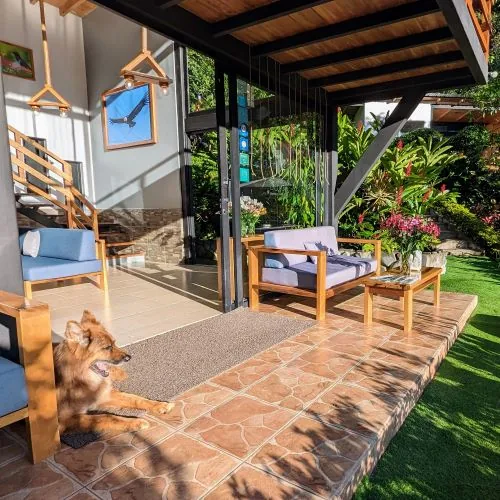
Two hours from Quito, the fog rolls over the ridgeline almost every morning. That fog is the point: Mindo sits in the Chocó Andino, a cloud forest where moisture from the Pacific gets trapped on the slopes and everything grows thick, wet and fast. Orchids on branches, bromeliads stacked on bromeliads, more bird species in one valley than in all of Europe.
We run a lodge here, and this page is the map of everything we've written about planning a Mindo trip. Start here, then follow the links for the details.
What the cloud forest actually is
A cloud forest is a montane forest that sits inside the clouds for much of the year. At Mindo's altitude (around 1,300 m in town, with birding sites from 1,100 m up to 2,500 m in the surrounding reserves) the air stays humid, temperatures are mild and rain shows up in short bursts rather than all-day downpours.
The result is biodiversity. The Mindo Christmas Bird Count has topped 400 species, the highest count in the world in several years. The Refugio Paz de las Aves reserve alone has 458 species registered on its eBird hotspot. In a single day of birding you can work three altitudes and plausibly see more than 30 hummingbird species: Booted Racket-tail, Violet-tailed Sylph, Brown Violetear, Green Thorntail.
You don't need to be a birder to care. The same forest feeds the waterfalls, the butterfly farm, the rivers people tube down, and the chocolate made from cacao grown on nearby slopes.
Temperatures and rain, in one paragraph
Expect around 21°C during the day and 14°C at night, year-round. The wetter stretch runs from late October through April; the middle of the year is drier but never dry. Brief showers happen in any month, usually in the afternoon. Pack a light rain jacket no matter when you come. For month-by-month notes, see our pages on visiting in June, July, August and December.
What there is to do
Birding. The headline activity. Dawn at a cock-of-the-rock lek (best around 6:00 AM), antpittas fed by hand at Refugio Paz de las Aves, hummingbird feeders buzzing at every reserve. A local guide costs A private half-day Mindo birding tour costs $100 total for up to two guests ($120 for three, $135 for four), with guide, scope, binoculars, transport and a pre-breakfast delivered the night before — about three and a half hours, starting at 6 AM. The half-day Chocó tour goes deeper into the hotspot for $240 total for two ($290 for three, $360 for four): 5:20 AM start, five hours, two birding-and-photography points and a full breakfast box included. More in our birding section.
Waterfalls. The Ruta de las Cascadas starts with a tarabita (open cable car) crossing over the Río Nambillo valley: $5 for adults, $3 for kids 5-11, cash. On the far side, a sanctuary with seven waterfalls and swimming pools. The Nambillo cascade is about 20 minutes on foot, the easiest walk; the five-waterfall circuit takes about 2 hours.
Butterflies. Mariposas de Mindo is about 1.6 km from town: $8.50 for adults, guided tour of the life cycle included, more than 25 native species.
Canopy and adrenaline. The full 10-cable zipline tour runs 3,500 m and costs $25 for foreign visitors; shorter tours of 6, 3 or 2 cables cost less. Tubing on the river runs $6 per person with a 4-person minimum. Sky bike $10.
Chocolate. Mindo Chocolate Makers (formerly El Quetzal de Mindo) runs tours for around $10, check current. Yumbos Chocolate also offers a $10 tour with 10 tastings.
Night walks. The forest changes shift after dark — the Hermit Night Walk ($15) is the one we send guests to: glassfrogs, kinkajous, owls.
How long you should stay
Honest answer: longer than a day trip. Mindo is close enough to Quito for a one-day dash, but the best hours in a cloud forest are early morning and late afternoon, and a day trip burns both of them on the road. We break down the trade-offs in Mindo day trip vs overnight. Two days and one night covers the classic loop; three or more lets you add higher-altitude reserves and slower mornings.
Getting there and getting around
Mindo sits about 2 hours from Quito by road. Your options: the Flor del Valle bus from La Ofelia terminal for $4.50 (schedules change often, check at the terminal), a private taxi for $80-90, or our own door-to-door transfer for $105. Full details in how to get to Mindo from Quito. Once in town, everything is walkable or a $3-5 taxi ride to the trailheads.
Where to stay
You can sleep in town (restaurants, walkable) or at a lodge outside it (forest at your door, birds before breakfast). We obviously have an opinion about the second option, and we lay out the honest comparison in where to stay in Mindo.
When to come
There is no bad month, only trade-offs: drier trails mid-year, greener forest and louder frogs in the wet season. Birding stays strong all year. Our full reasoning is in the best time to visit Mindo.
Quick questions
Price of the tarabita, altitude, safety, whether you need a guide: we answer the most common ones in the Mindo FAQ.
Facts checked: September 2026