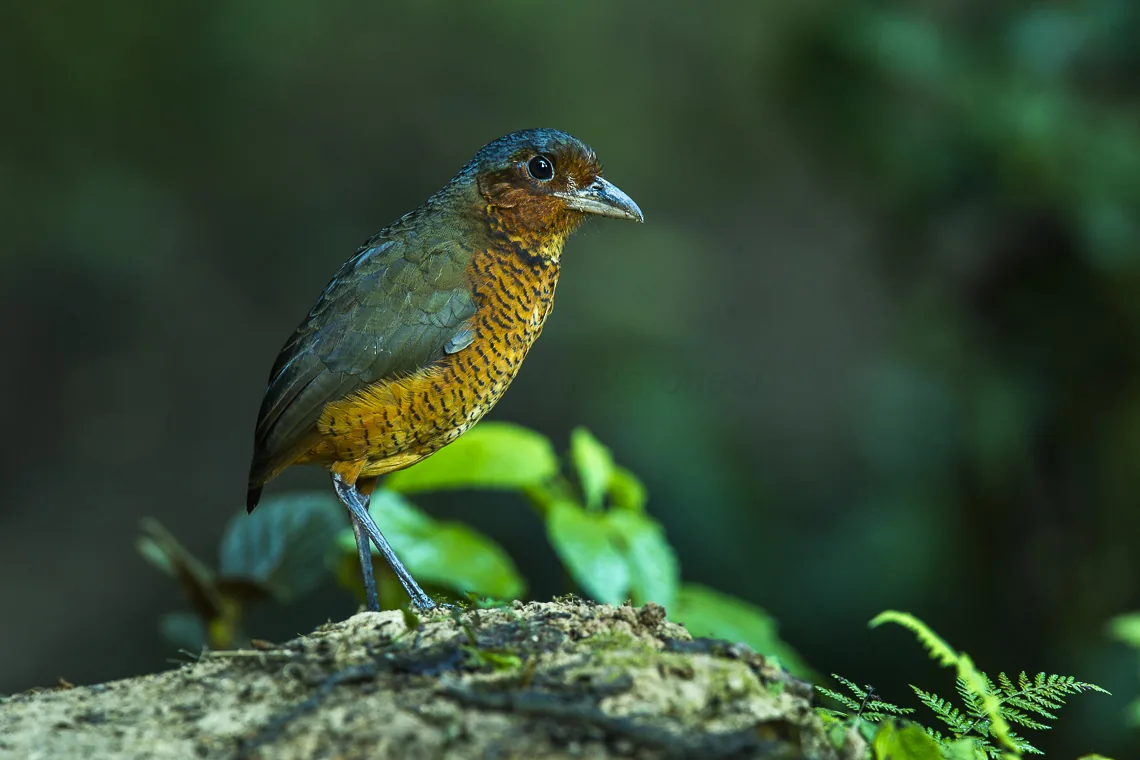
Photo: Francesco Veronesi from Italy (CC BY-SA 2.0) via Wikimedia Commons
Somewhere in the Ecuadorian cloud forest a man is calling "María. María!" down a dark hillside, and a bird the size of a softball with legs like a roadrunner hops out of the undergrowth and takes an earthworm from his hand. This happens every morning at Refugio Paz de las Aves, and it is one of the strangest, best things in South American birding.
What Paz de las Aves is
Ángel and Rodrigo Paz were farmers who, more than 20 years ago, stopped clearing their forest and started protecting it. They learned that individual antpittas respond to names, and that these famously secretive birds would come to worms if you were patient enough. Today the reserve's eBird hotspot lists 458 species, but the fame rests on six antpitta species that feed at named stations, each bird summoned by name.
Antpittas are the birds every birder wants and almost nobody sees. They lurk in dark understory, they sing from hidden perches, and in most of their range a glimpse counts as a triumph. At Paz de las Aves you watch giant antpittas, yellow-breasted and chestnut-crowned and more, standing in the open eating worms a few meters away. It rewrites what you thought was possible with wild birds.
The half-day tour
| Detail | Info |
|---|---|
| Departure | 5:30-6:30 AM from the reserve |
| Duration | about 6 hours |
| Includes | Andean cock-of-the-rock lek, antpitta feeding, breakfast, hummingbird garden, feeders |
| Distance from Mindo | about 30 min |
| Entry price | check current prices (not published openly) |
| Longer stays | 3d/2n, 4d/3n and 7d/6n Chocó Andes programs; lodge has just 4 rooms |
The morning runs in a fixed rhythm because the birds run it. First the cock-of-the-rock lek at dawn, then breakfast, then the antpitta circuit: a different name called at each station, a different bird hopping out. The Paz family also puts out fruit for tanagers and oropendolas, so the quieter stretches between antpittas fill with color.
Our honest opinion: this is the single best value birding experience in the Mindo region, and it works even if you do not keep a life list. Book the half-day tour; the full lodge programs make sense only if you want several days deep in the Chocó.
The birds, in order of fame
- Giant antpitta ("María" and friends) — the headline act, a football with legs.
- Yellow-breasted antpitta — the most regular performer.
- Chestnut-crowned and slate-crowned antpittas — shyer, often the reward for waiting quietly.
- Moustached antpitta — the rarest of the set and a serious target for world listers.
- Ochre-breasted antpitta — smaller, perches motionless like a mournful figurine.
Which species show on a given morning is weather and luck dependent. Six is a good day; two or three is still a morning no other destination can offer. Names of individual birds change over the years as new birds get trained in — your guide will introduce the current cast.
Getting there
The reserve sits past Nanegalito, roughly 2 hours from Quito and about 30 minutes from Mindo. From Quito without a car, buses leave from the Carcelén or La Ofelia terminals toward Nanegalito, then a taxi covers the last stretch. From Mindo, any lodge can arrange the early transfer — the 5:30 AM start is the one logistical detail that makes staying in town the night before worth it. Climate up there runs around 21°C by day and 14°C at night, with frequent rain from late October to April.
Photographing antpittas
Easier than you would expect. Birds stand in the open at close range in shaded forest, so:
- Shoot at f/2.8-f/4 with ISO 1600-3200; the forest light is dim but the birds hold still while feeding.
- Focus on the eye. Worm strikes are fast; the pose before the strike is the money frame.
- Keep flash off unless your host allows it. Most stations are dark enough that it helps, but ask first — it is their forest and their birds.
Etiquette
The worm-feeding looks like a circus act and is actually a delicate trust built over years. Keep quiet when the guide is calling, stay where they put you, never try to feed or call birds yourself, and no flash during the summoning. If a bird does not come out, it does not come out — the family will not chase it, and neither should you ask them to.
Is it worth the early alarm?
If you are reading this page, yes. Even casual wildlife travelers rank Paz de las Aves as their Mindo highlight, ahead of waterfalls and zip lines. The combination of dawn lek, named antpittas and hummingbird garden in one six-hour morning has no equivalent we know of anywhere in the Americas.
Start here
- The Andean cock-of-the-rock lek — happens first on the same tour
- Refugio Paz de las Aves: visiting guide
- Birdwatching in Mindo
- Hummingbirds of Mindo
- How to get to Mindo from Quito
Facts checked: September 2026