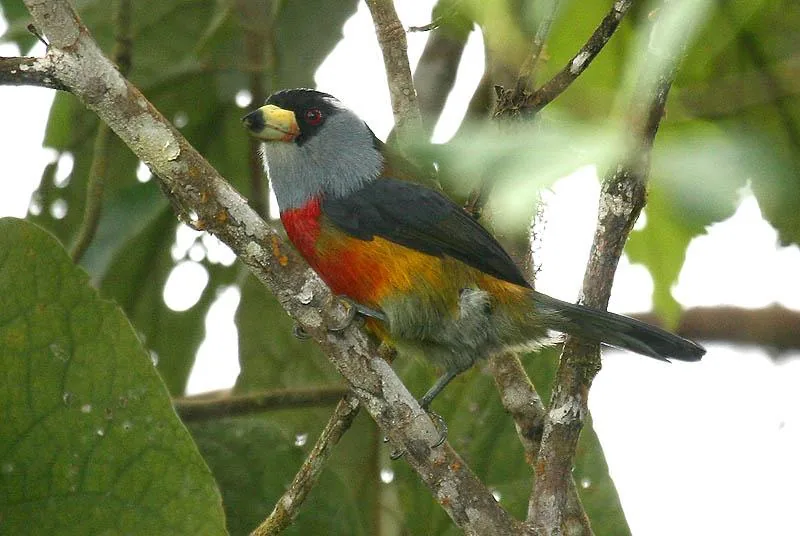
Photo: Michael Woodruff from Spokane, Washington, USA (CC BY 2.0) via Wikimedia Commons
Mindo sits inside the Chocó Andino, a region on the west slope of the Ecuadorian Andes where the bird list is unreasonable by almost any standard. Refugio Paz de las Aves alone has recorded 458 species on its eBird hotspot. A town of about 1,200 people keeps roughly 60 certified birding guides busy. That density of birds and of people who know how to find them is the whole argument for coming here.
Why so many birds in so little space
Elevation does most of the work. Around Mindo you can bird three altitude bands in a single day: roughly 1,100 m around town, 1,800 m up the Tandayapa side, and 2,500 m toward the high passes. Birds that never meet each other live an hour's drive apart. A typical day that covers all three can turn up 30+ hummingbird species, which is more than many entire countries list.
Add the Chocó endemics, species that exist almost nowhere else outside this narrow strip of northwest Ecuador and western Colombia, and you get the hotspot label. Birds like the Chocó toucan, the plate-billed mountain toucan and the toucan barbet pull birders from every continent, and most of them are findable on regular day trips from Mindo.
The reserves around Mindo
You do not need to enter deep wilderness. A ring of private reserves covers the slopes, each with its own altitude and specialty.
| Reserve | Elevation | Distance from Mindo | Known for |
|---|---|---|---|
| Refugio Paz de las Aves | ~1,700 m | ~30 min | Antpittas fed by hand, cock-of-the-rock lek, 458 species on eBird |
| Milpe Bird Sanctuary | 1,050-1,150 m | ~1 h | Chocó endemics, manakin leks, 247 acres protected since 2004 |
| Río Silanche Bird Sanctuary | 325-410 m | ~1.5 h | Lowland foothill species, ~100 ha protected by Mindo Cloudforest Foundation |
| Bellavista Cloud Forest Reserve | ~2,000+ m | ~1.5 h | Higher-elevation cloud forest, entry around $10, open 7:30 am-6 pm |
| Mashpi Amagusa Reserve | ~1,000-1,300 m | 1.5-2 h | Chocó endemics at feeders, ~320 acres |
| Yanacocha Reserve | 3,200-3,400 m | ~1.5 h | High-elevation hummingbirds on the Pichincha slope |
Entrance fees vary and not every reserve publishes them. Check current prices before you go, or let your guide arrange it, which they usually do.
How to structure your days
One day rarely does the hotspot justice. A sensible split:
- Day 1, low and mid: Milpe or Río Silanche in the morning for lowland tanagers and manakins, feeders near Mindo in the afternoon.
- Day 2, the Paz experience: a dawn start around 5:30-6:00 am for the cock-of-the-rock lek, then antpittas, then hummingbird feeders.
- Day 3, high: Yanacocha or the Tandayapa road for mountain species, ending at Bellavista.
If you only have one day, we would skip the lowlands and spend it between Paz de las Aves and the hummingbird gardens. Antpittas and a lek beat a long drive.
Going with a guide or on your own
The trails are walkable and some reserves are signposted, but the endemics are not. Local guides know which lek is active, which feeder has the racket-tail this week, and where the road washed out. From Las Terrazas de Dana, a half day with a guide runs A private half-day Mindo birding tour costs $100 total for up to two guests ($120 for three, $135 for four), with guide, scope, binoculars, transport and a pre-breakfast delivered the night before — about three and a half hours, starting at 6 AM. The half-day Chocó tour goes deeper into the hotspot for $240 total for two ($290 for three, $360 for four): 5:20 AM start, five hours, two birding-and-photography points and a full breakfast box included.
Where this fits in a longer trip
Mindo is about 2 hours from Quito, which makes the Chocó Andino an easy add-on to any Ecuador itinerary. If you are deciding how many days to give it, read our birdwatching in Mindo guide for the overview, then the species pages: hummingbirds, toucans and tanagers. For the dawn show, see the cock-of-the-rock lek and the Paz de las Aves experience.
Facts checked: September 2026