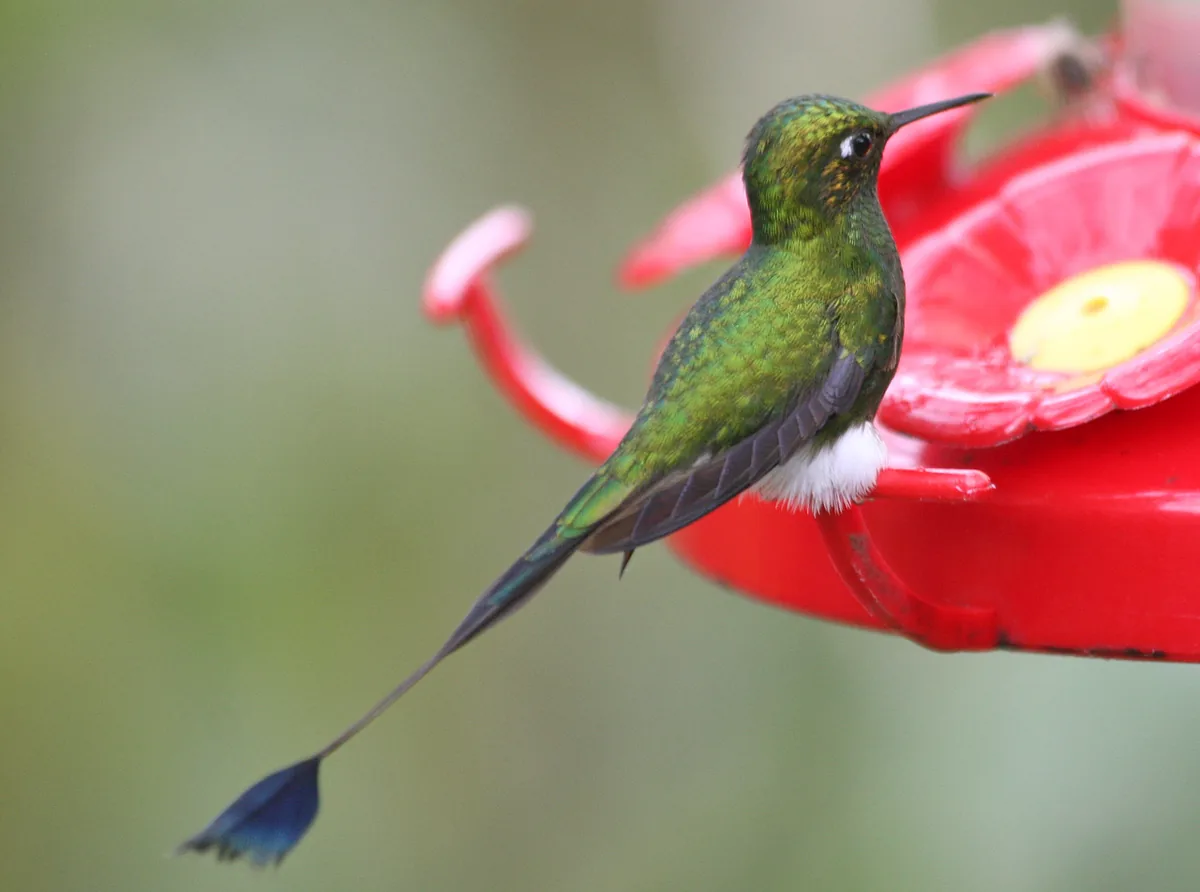
Photo: Soler97 (aka Tad Boniecki) at en.wikipedia (Public domain) via Wikimedia Commons
The first hummingbird most visitors meet in Mindo is a booted racket-tail, and it does something unfair: it hovers a meter from your face with legs like tiny feathered pants, then vanishes before your camera focuses. After that, every green blur in the garden becomes an event. Mindo is one of the easiest places on the continent to see 20 hummingbird species in a single day, and you do not need to hike anywhere to do it.
Why so many species in one valley
Hummingbirds divide territories by altitude. Mindo sits at about 1,300 m with birding sites ranging from roughly 1,100 m up to 2,500 m within a short drive. Each elevation band hosts a different set. That is why a focused hummingbird day can log 30+ species: you are not walking far, you are driving between bands and sitting at feeders tuned to each one. Local operators run exactly this circuit as a dedicated toucan-and-hummingbird tour, precisely because the altitude trick works.
The species you will actually remember
Some hummingbirds are green. The Mindo stars are not:
- Booted racket-tail — tiny, white-legged, with two tail streamers like badminton shuttlecocks. Comes to lower-altitude feeders.
- Violet-tailed sylph — a long shimmering tail that looks Photoshopped even in person.
- Brown violetear — big, loud, dominant at feeders; the bully everyone eventually roots against.
- Green thorntail — compact with a white rump band, often at higher-elevation feeders.
- Purple-bibbed whitetip, velvet-purple coronet, white-whiskered hermit — among the Chocó endemics you can pick up without leaving a garden.
The audubon-listed icons above are a fair sample of what feeders here produce. Long-tailed sylphs, fawns and wedges wait up the mountain.
Where to see them
Three kinds of places work, and we recommend mixing them:
| Venue type | What you get | Typical cost |
|---|---|---|
| Hummingbird gardens near town (feeders) | 10-15 species up close, easy photos | check current entry |
| Reserve feeders up in altitude | rarer species (thorntails, mountain gems) | check current entry |
| Garden at your lodge | whatever visits that morning, free | included |
The famous feeding stations sit at reserves a short drive from town. Most open mid-morning and stay busy all day, which makes them the perfect second stop after an early forest walk. If you stay with us at Las Terrazas de Dana, the garden feeders start working before breakfast and nobody charges you to stand there.
Photographing hummingbirds in Mindo
The honest advice:
- Feeders make it easy. Birds return to the same perch every 30 seconds. Pre-focus, wait, shoot.
- Flash sells the colors. Hummingbird iridescence is structural color, not pigment. Without hard light, a violet-tailed sylph looks brown. Many feeding stations allow flash; ask first.
- Shutter speed 1/1600 or faster unless you want wing blur on purpose.
- Morning light beats midday. The gardens sit under open sky, so harsh noon light flattens everything.
For a deeper dive, see our page on bird photography in Mindo.
When to go
Any month. Hummingbirds are resident, they feed in rain, and the feeders never close. The only seasonal question is comfort: showers are more frequent from late October through April, and you will want a rain shell regardless of when you come. Mornings are reliably dry more often than afternoons.
Pair it with the rest of your day
Hummingbird gardens open late and charge little, which makes them the natural afternoon block after a dawn lek or an antpitta morning. Two reliable combinations:
- Cock-of-the-rock at dawn → breakfast → hummingbird garden by 9 AM. The two signature Mindo experiences in half a day.
- Full guided forest morning → afternoon at the feeders. Your guide rests, you add species.
Common questions
Do I need a guide for hummingbirds? No. Feeders are self-explanatory and every species has signs or posted photos. A guide adds altitude-band strategy, not identification help.
How much time should I plan? Ninety minutes at a good garden is plenty. Photographers can lose half a day, happily.
Are the feeders bad for the birds? The reserves run them as part of active conservation projects, and the species lists keep growing rather than shrinking. We are comfortable with that trade, and it funds habitat protection.
Start here
- Birdwatching in Mindo — the complete guide
- The Andean cock-of-the-rock lek
- Antpittas at Paz de las Aves
- Toucans of the Mindo cloud forest
- Bird photography in Mindo
Facts checked: September 2026