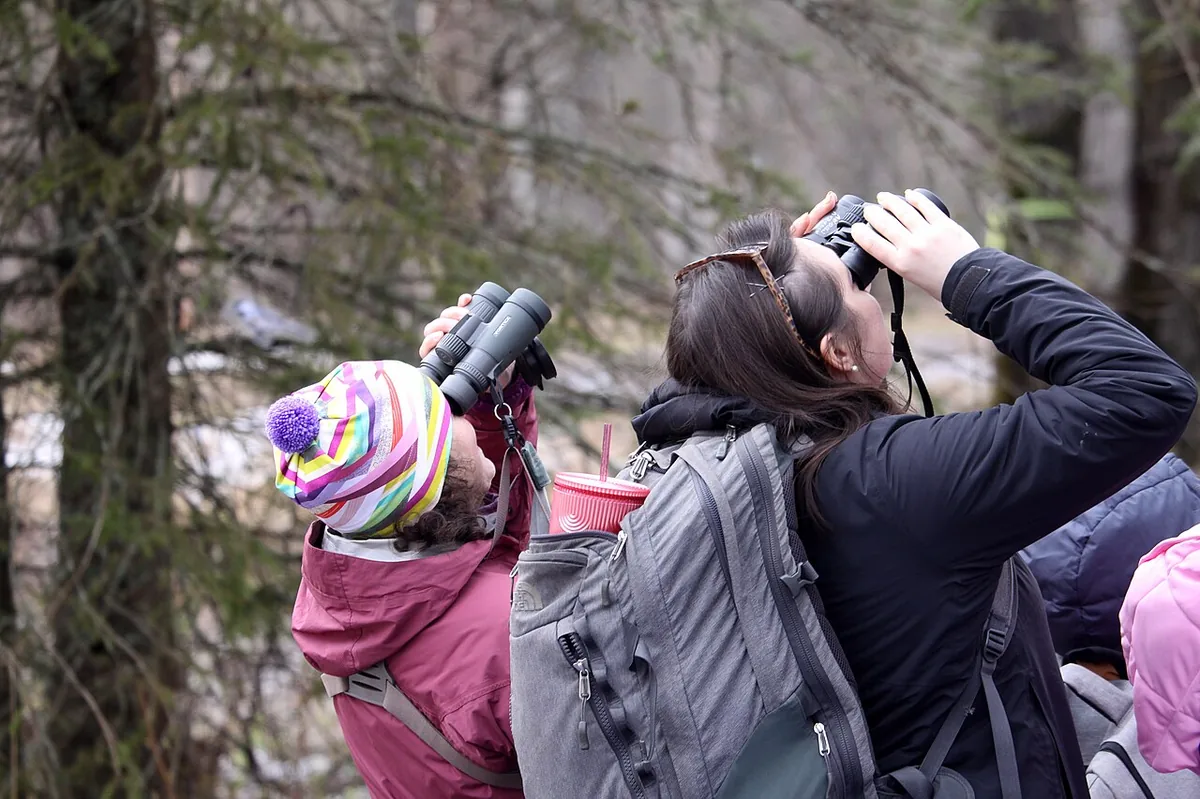
Photo: BLM Alaska (Public domain) via Wikimedia Commons
Nobody arrives in Mindo an expert, and Mindo does not care. This is one of the friendliest places on earth to learn birdwatching because the birds here are absurd — the first hummingbird that hovers a meter from your face does not require any skill to appreciate. If you have never owned binoculars but you are curious, this page is the plan.
Your first morning, step by step
Skip the alarm-heroics. Here is what works:
- Drink your coffee in the garden. At this lodge the feeders are working before breakfast, and the first fifteen species of your life list arrive while you are still half awake. Booted racket-tails, violetears, tanagers.
- Walk out of town along the river or the cascade road. Early, before traffic. The edge habitat along the Río Nambillo is where the mixed flocks pass.
- Stop at a feeding station mid-morning. Several reserves around Mindo put out fruit and nectar. Everything is close, labeled and slow. This is where you learn to actually identify things.
- Quit at lunch. Bird activity drops hard by 10–11 AM. Napping is a legitimate birding technique here.
That is a realistic 15–25 species on day one, zero guide, zero stress.
What to bring
- Binoculars if you own them. 8x42 is the standard recommendation. If you don't own any, rent or borrow locally — many guides and lodges have pairs. Check current availability.
- A rain shell. Always. Mindo can be dry all morning and deliver a short heavy shower at 2 PM.
- Closed shoes with grip. The trails are muddy and the mud is slick.
- Your phone with a bird app. Merlin covers Ecuador and works offline if you download the pack.
What you do not need: a spotting scope, a field vest, camouflage anything, or a 600 mm lens.
When to spend on a guide
A half day with a certified guide is A private half-day Mindo birding tour costs $100 total for up to two guests ($120 for three, $135 for four), with guide, scope, binoculars, transport and a pre-breakfast delivered the night before — about three and a half hours, starting at 6 AM. The half-day Chocó tour goes deeper into the hotspot for $240 total for two ($290 for three, $360 for four): 5:20 AM start, five hours, two birding-and-photography points and a full breakfast box included. Spend the money when:
- You want the hard birds (antpittas, the mountain toucans, lek behavior explained).
- Your trip is short and you cannot afford wasted mornings.
- Someone in the group is a serious birder and the rest are not — a good guide runs both speeds at once.
For your first casual morning, you genuinely do not need one. Start in the garden and the feeders; hire the guide on day two once you know you are hooked.
The beginner traps
- Trying to identify everything. Let half the birds go. The blue-gray tanager will show up forty more times; save your focus for new ones.
- Birding at noon. Nothing is wrong with you; the birds are napping. Go back out at 4 PM.
- Walking too fast. Flocks announce themselves by sound. If you rush, you walk under them.
- Judging the trip by numbers. The point on day one is learning to see, not logging 60 species.
Where to go next
Once the easy stuff is fun, the classic Mindo progression is the cock-of-the-rock lek at dawn (book ahead, best around 6 AM), the antpitta experience at Paz de las Aves about 30 minutes from Mindo, and then the altitude game — three bands from 1,100 to 2,500 m, each with a different set of birds.
Start here
- Birdwatching in Mindo — the complete guide
- Hummingbirds of Mindo
- The Andean cock-of-the-rock lek
- Best time for birdwatching in Mindo
- Three altitudes in one day
Facts checked: September 2026