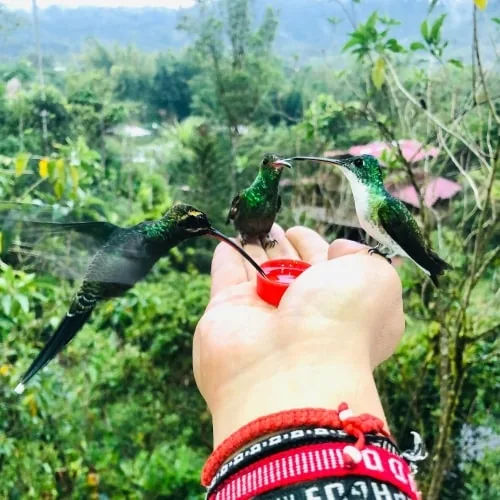
Mindo is one of the easiest places in the Americas to come home with strong bird photos, and the reason is infrastructure. You do not need to track birds through dense forest. You need to know where they are already standing still.
Feeders: where most good photos happen
The hummingbird gardens around Mindo are working photography studios, whether they admit it or not. Feeders bring in 20+ species at some sites, and the perches are predictable. Species like the booted racket-tail, violet-tailed sylph, brown violetear and green thorntail visit the same flowers and feeders dozens of times an hour.
Practical notes for shooting hummingbirds:
- Light in the cloud forest is dim and diffuse. Fast primes or a lens at f/2.8-f/4 help, and high ISO is a given.
- Cloud cover is your friend: it softens the iridescent plumage that harsh sun blows out.
- Some gardens offer multi-flash setups; ask locally if that interests you.
Land birds photograph well at feeders too. Fruit feeders draw tanagers, toucanets and barbets to the same perch repeatedly, which lets you pre-focus and wait.
Hides and antpitta feeding
The most distinctive photography experience near Mindo is the antpitta worm-feeding at Refugio Paz de las Aves, where six antpitta species come to worms offered by hand. You photograph from a fixed spot while the reserve's team calls the birds in. Combined with the dawn cock-of-the-rock lek (best around 6:00 am), a half-day tour there delivers portraits of birds that are nearly impossible to photograph elsewhere.
Other reserves near Mindo have built covered hides. La Victoriana, for example, has a two-level covered hide with clear forest views. Check current access and prices with your lodge or guide, since not every reserve publishes fees.
Tours and guides
A guide earns their fee for photographers more than for listers. Guides know which feeder has which species this week, position you for light and background, and can quietly set up perches.
From Las Terrazas de Dana we arrange guided birding directly: A private half-day Mindo birding tour costs $100 total for up to two guests ($120 for three, $135 for four), with guide, scope, binoculars, transport and a pre-breakfast delivered the night before — about three and a half hours, starting at 6 AM. The half-day Chocó tour goes deeper into the hotspot for $240 total for two ($290 for three, $360 for four): 5:20 AM start, five hours, two birding-and-photography points and a full breakfast box included. Tell us your gear and target species and the day gets built around them.
Gear: what actually matters here
- Rain protection is not optional. Cloud forest means moisture on everything. A rain cover, dry cloth and silica gel live in our camera bags.
- Zoom beats reach. Forest shots are often 3-10 m, not 30 m. A 300-500 mm equivalent covers nearly everything, and feeders let you shoot at 200 mm comfortably.
- Fast memory and batteries. Hummingbird bursts eat cards; cool damp mornings eat batteries.
- A small tripod or monopod helps at hides, though most feeder work is handheld.
How many days to plan
One day covers a lek, antpittas and one good feeder garden. Two to three days adds reserves at different elevations, and the species mix changes with each climb. Our best time for birdwatching in Mindo page covers when the light and activity are best; the birdwatching in Mindo guide gives the full species picture. If specific birds drive your trip, see hummingbirds of Mindo, toucans of Mindo and the Paz de las Aves experience.
Facts checked: September 2026