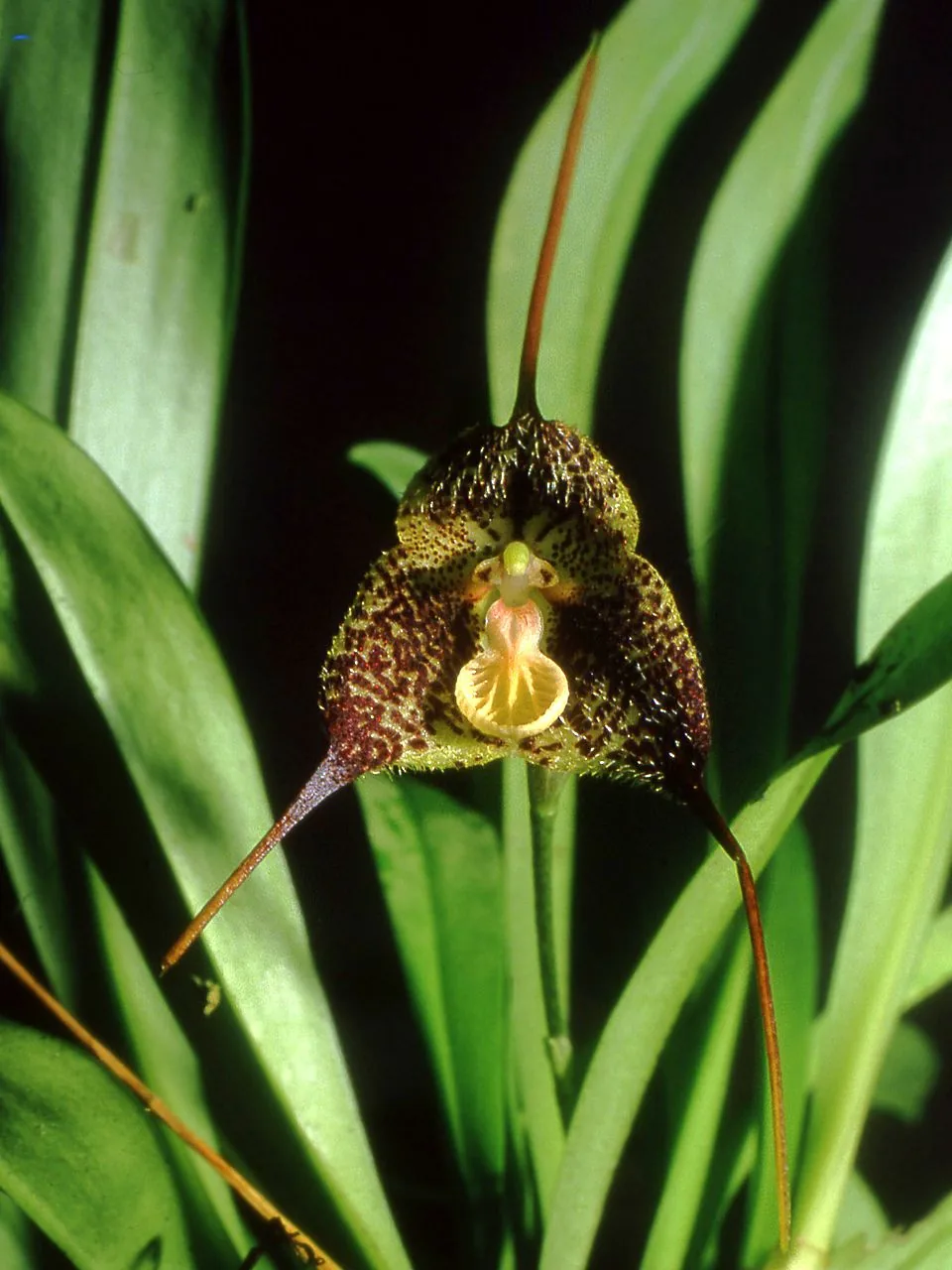
Photo: Orchi (CC BY-SA 3.0) via Wikimedia Commons
Everyone walks past a hundred orchids before someone points at one. In the Mindo cloud forest they are not the giant potted flowers of a garden center — most are smaller than your thumb, growing on a mossy branch at shoulder height, and once your eyes learn the shape you start seeing them everywhere. Ecuador is one of the most orchid-rich countries on earth, and the Mindo valley sits in the middle of the richness.
Facts
| Where | orchid gardens in and near town; reserves and trails throughout the valley |
| Entry | gardens and reserves vary — check current prices |
| Tour | guided orchid walks available in town — check current prices |
| Best hours | daytime; many species open flowers in the morning |
| Seasons | year-round; individual species bloom in their own windows |
Three ways to see them
1. An orchid garden. The easiest and best for learning. Several collections in and around Mindo grow native orchids labeled and blooming, and a short guided visit teaches you the main genera — what a pleurothallis looks like versus a masdevallia, which ones smell like cinnamon, which one mimics an insect. If you do one orchid activity, do this one first; it calibrates your eyes for the trails.
2. The reserves. In the cloud forest reserves at 1,800 m and above, orchids are the structural decoration of the forest — hanging from branches, crowding the trail edges, climbing the trunks. Naturalist guides find species after species here; without a guide you will find epiphytes in general, which is still beautiful.
3. Slow walking, anywhere. The honest secret: orchids are densest along damp shaded trails, and Mindo's town-edge trails have them too. Walk slowly, look at eye level and below, and the small things start resolving out of the green.
What you might see
Without listing 400 possible species, the signature groups are:
- Masdevallias and draculas — the strange ones, with flowers like wax lanterns or faces; favor the cool, wet upper forest.
- Pleurothallis and relatives — the "bonsai" orchids, hundreds of small-flowered species, everywhere.
- Oncidiums and Cyrtochilum — the sprays, with Dancing-lady yellow flowers on long stems.
- Epidendrums and Maxillaria — the common structural orchids of every trunk.
Garden guides usually have a "today in bloom" list that changes weekly, which is the right way to experience a place where something different flowers every month of the year.
When to come
There is no single orchid season in the cloud forest — the forest is wet year-round and different species flower in different months. Visits in the wetter months (late October through April) tend to produce more flowers per meter of trail; the drier months give you easier walking. If orchids are your main goal, tell the lodge when booking and we will steer you to whichever garden and reserve is peaking that week.
Photographing them
Orchids reward the patient, not the long-lens crowd:
- A short macro or a phone at 0.5x held close beats a telephoto.
- Cloud forest light is already diffused — no flash needed for most.
- Watch the background: one step sideways usually buys you a clean dark green instead of a tangle.
- Never move, cut or "tidy" anything around a flower. The neighbors are part of it.
Pair it
Orchid garden in the morning, hummingbird feeders at lunch, the Hermit Night Walk after dinner — the three easiest nature hours in Mindo, none requiring early alarms. For the plants as a whole, not just the orchids, see our flora of the Mindo cloud forest page.
Start here
- Flora of the Mindo cloud forest
- Cloud forest explained
- Night walks in Mindo
- Mindo-Nambillo reserve
- One day in Mindo
Facts checked: September 2026