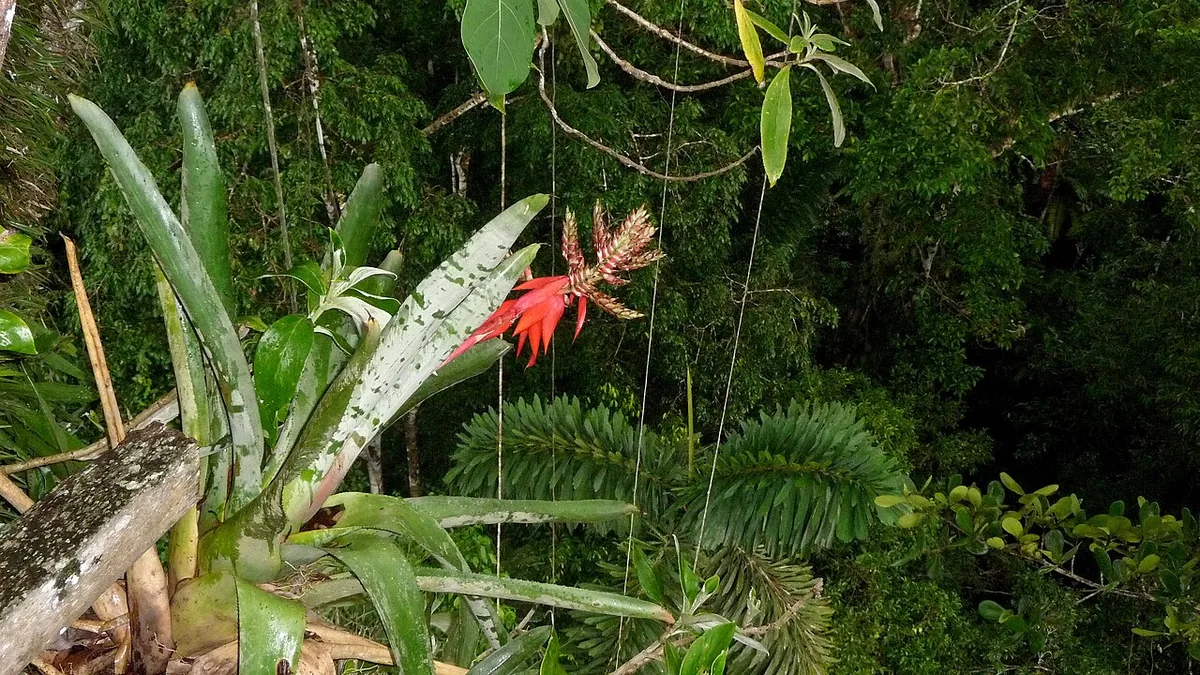
Photo: gailhampshire from Cradley, Malvern, U.K (CC BY 2.0) via Wikimedia Commons
Visitors come for the birds and leave photographing trees. That is not a cliché about Mindo; it is a description of what happens to anyone who walks here with their eyes open. The cloud forest's most distinctive life is the stuff that does not move: an entire ecosystem stacked on the branches, meters of moss, and orchids in places nobody looks until a guide points.
The epiphyte city
An epiphyte is a plant that grows on another plant without parasitizing it — it roots on bark and drinks from fog and rain. Cloud forests are the world capital of epiphytes because moisture is near-constant, and Mindo's forests wear the full set:
- Mosses and liverworts — covering trunks and branches so thickly that branches look upholstered.
- Bromeliads — the tank-shaped rosettes that hold pools of water in their leaf bases. Each tank is a small aquarium: tadpoles, insects, and frogs raise young in them meters above the ground. Spectacled bears eat bromeliads by the armful, which tells you how abundant they are.
- Ferns — from soil-level tree ferns that look like green umbrellas to tiny ferns growing inside moss cushions.
- Orchids — see below.
Walk the same trail twice and notice that virtually no branch surface is bare. That is the difference between a cloud forest and almost any other forest.
Orchids
Ecuador is one of the world's richest countries for orchids, and the cloud forest belt — Mindo's altitude band — is where most of them live. Most orchids here are epiphytes, small-flowered and subtle rather than the corsage type: hundreds of species, many known only from narrow altitude ranges on these Andean slopes.
Finding them is the skill. On your own you will walk past most; guides spot them constantly, and reserves around Mindo maintain orchid trails and gardens where species are labeled and blooming plants are concentrated. Ask at any reserve whether they have an orchid section — most do.
Honest note: flowering varies by species and season, so a trail that is spectacular in one month can be quiet in another. We will not pretend there is a single "orchid month" to book around; ask locally what is blooming.
Heliconias, and the birds that follow them
Heliconias — the hanging lobster-claw plants of the tropics — are the cloud forest's gas stations. Their flowers hold nectar for hummingbirds, and the plant's fortunes are tied to the birds': white-whiskered hermits and other long-billed species pollinate them in a relationship so tight that both plants and birds specialize by flower shape. Any trail with heliconia thickets is a good hummingbird stakeout. Stand still near them in the morning and count.
The big plants
- Tree ferns. Survivors of an older world, waist-high trunks crowned with fronds. Common on wetter trails; the young fronds uncurl as fiddleheads.
- Cecropia. The pale-trunked, open-crowned trees with umbrella leaves; their fruit feeds tanagers and toucans, and their hollow stems house Azteca ants. Great "why is that bird there" answer: cecropia.
- Palm heaven and bamboo stands — structure for the mixed flocks that birders chase.
Why fog makes this possible
Everything above runs on the fog-combing mechanism: leaves intercept cloud moisture, water runs down trunks, streams stay alive. When forest is cleared, the fog belt does not stop — but there is nothing left to catch it, streams flash-flood and dry, and the epiphyte city desiccates. This is why cloud forest explained matters as a concept and not just scenery: the plants are the infrastructure.
Where to look at plants around Mindo
| Place | What to expect |
|---|---|
| Reserve trails near town | mossy understory, heliconias, ferns; add a guide for orchids |
| Ruta de las Cascadas | streamside plants, puddling butterflies on the flowers |
| Higher-elevation reserves | different plant bands; more moss, orchids, tree ferns |
| Town gardens and lodge grounds | heliconia and hummingbird plantings; good for beginners |
Rules of the forest
- Do not pick, and do not "rescue" orchids or bromeliads as souvenirs — most die in transit, and removal from reserves is illegal.
- Stay on trails; epiphyte-laden understory recovers slowly from trampling.
- Buy plants only from licensed nurseries, never from roadside sellers claiming forest origin.
Keep reading
- Cloud forest explained — the ecosystem these plants build
- Hummingbird species guide — the birds the flowers are built for
- Butterflies of Mindo — the caterpillars eating all of it
- Ecuador: a biodiversity hotspot — the national picture
Facts checked: September 2026