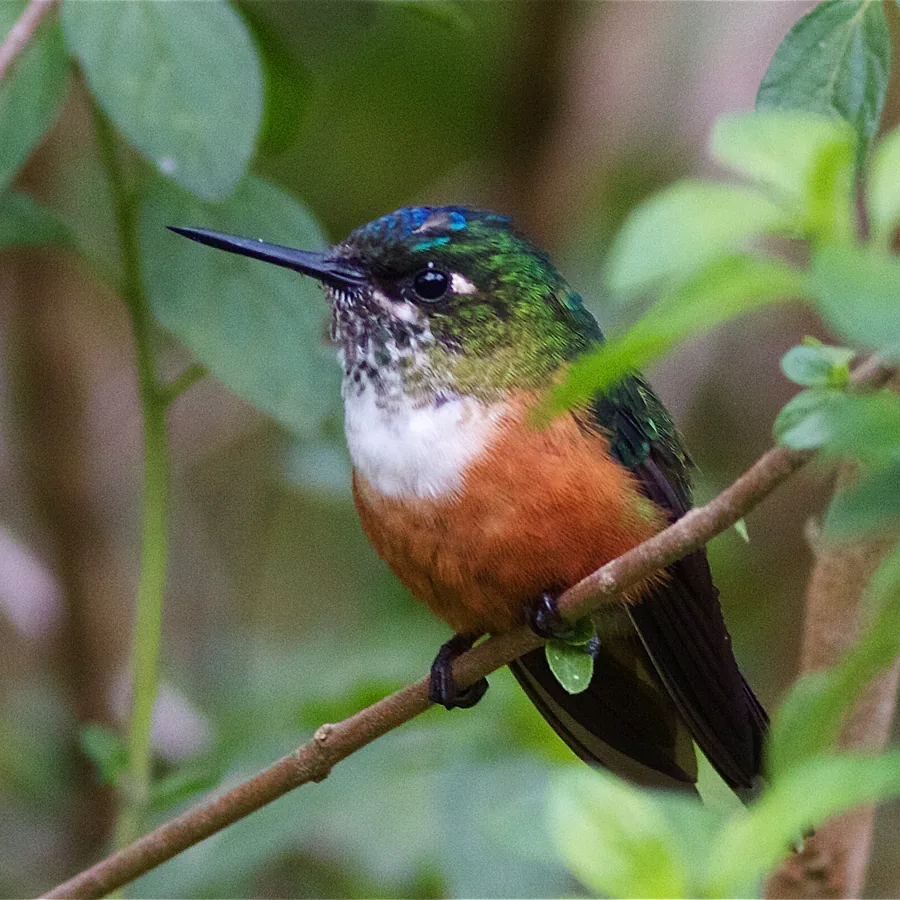
Photo: Joseph C Boone (CC BY-SA 3.0) via Wikimedia Commons
The birding pages on this site cover the hummingbird circuit from the practical side. This page is the identification side: who's who at the feeders, how the altitude bands sort the species, and how to tell the green ones apart — because in Mindo, roughly half your hummingbird list at first glance is "small green hummingbird," and half the fun is splitting them.
The altitude trick, again but properly
Hummingbirds partition mountains. Mindo's birding sites span roughly 1,100 m to 2,500 m, and each band has its own set — which is why a dedicated day moving between bands can log 30+ species. Rough guide:
| Band | Elevation | Who you meet |
|---|---|---|
| Valley / town feeders | ~1,100-1,400 m | booted racket-tail, violet-tailed sylph, brown violetear, white-whiskered hermit |
| Mid-elevation reserves | ~1,500-1,900 m | green thorntail, purple-bibbed whitetip, velvet-purple coronet, empress brilliant |
| Upper reserves | ~2,000-2,500 m | mountain gems, sunangels, high-elevation metaltails |
One site lists around 22 hummingbird species at its feeding area alone. Learn the bands and you know where to look before you arrive.
The feeder regulars, one by one
- Booted racket-tail. The smallest star. White "boots" on the legs, two tail streamers ending in rounded raquets. Males do a sideways shuttle display at flowers. Unmistakable.
- Violet-tailed sylph. Long iridescent blue-violet tail, green body. Females have a shorter tail but keep the color.
- Brown violetear. The largest and the loudest at feeders; a bully with violet ear patches. When the garden explodes into chasing, it is usually this one's fault.
- Green thorntail. Small, with a white rump band and — in males — a deeply forked tail. Prefers the mid-elevation feeders.
- White-whiskered hermit. A brown, long-billed hummer of the forest interior with white facial stripes; comes to heliconia flowers more than feeders. Seeing one well means walking a trail, not sitting at a feeder.
- Velvet-purple coronet. Big, dark, spectacular — violet body, green wings, glows when the light hits right. One of the Chocó's best.
- Empress brilliant and purple-bibbed whitetip. Mid-elevation specialists; the whitetip's name tells you where to look.
Telling the small green ones apart
The generic "green hummingbird" bucket splits on four characters:
- Tail shape — forked (thorntail), rounded, or with racket streamers.
- Size relative to a sylph — sylphs look long; woodstars look like flying bees.
- Bill — short and straight, long and decurved (hermits), or needle-thin.
- Behavior — perch-and-sip vs hover-only, feeder dominance, display flights.
Get those four and the field guide sorts the rest. Honestly, though: at Mindo's feeders even the confusion is enjoyable, and by day two most visitors ID the regulars instantly.
Endemics: why this list is special
Several of the species above are Chocó endemics — found nowhere else on Earth but this strip of Andean west slope. The Chocó Andino is a recognized biodiversity hotspot, and hummingbirds are its most visible expression: when habitat here disappears, these species have no fallback population elsewhere. It is why reserves around Mindo treat their feeders as part of funded conservation programs rather than amusement.
Photography quick notes
- Structural color needs hard light — flash or strong side sun — or a violet-tailed sylph photographs brown.
- 1/1600s or faster freezes wings; slower is a creative choice, not a mistake.
- Pre-focus on a favorite perch; feeders make birds predictable.
- The full workflow is on bird photography in Mindo.
Where to start
- Hummingbirds of Mindo — the practical feeder circuit, costs and timing
- Birdwatching in Mindo — the complete guide
- Antpittas at Paz de las Aves — pair the feeders with the worm-feeding show
- Cloud forest explained — the habitat behind the list
Facts checked: September 2026