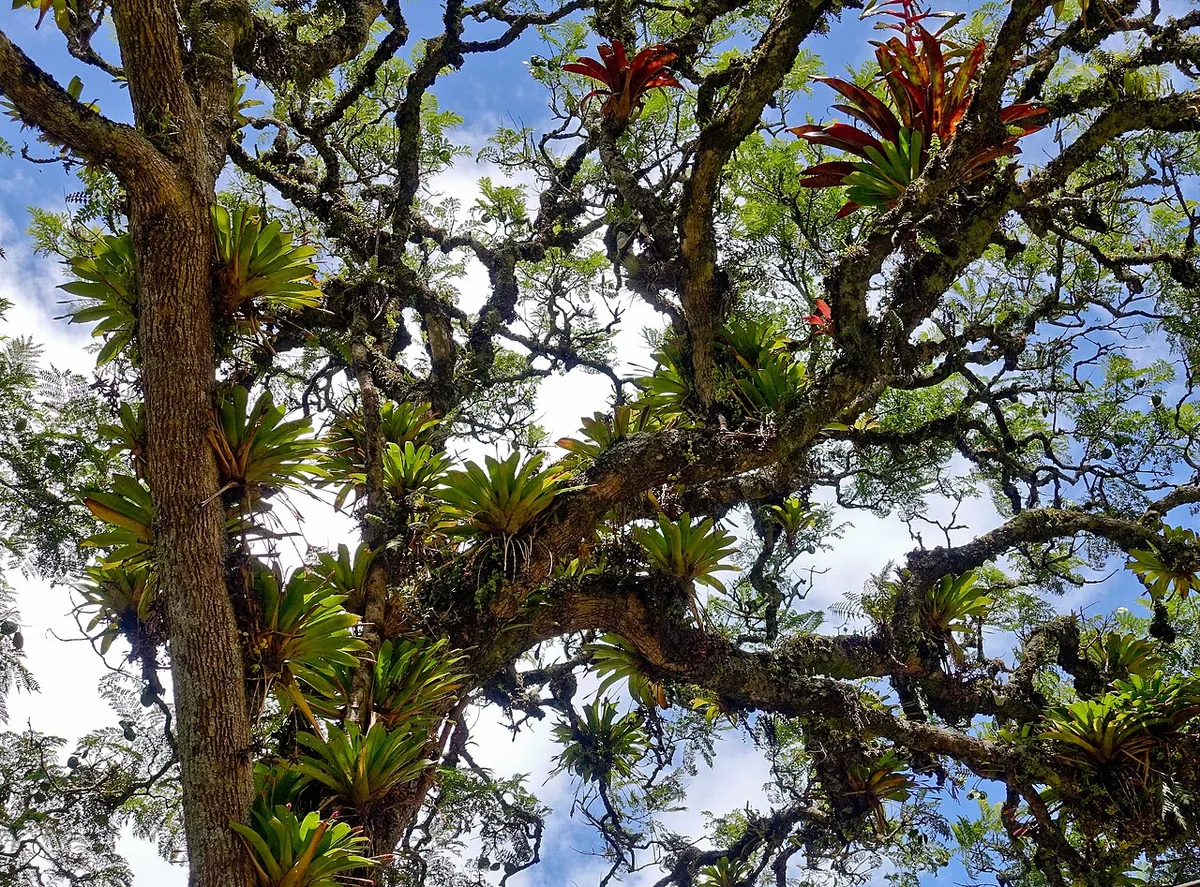
Photo: Fährtenleser (CC BY-SA 4.0) via Wikimedia Commons
Stand in Mindo at seven in the morning and the explanation arrives before the definition does. Fog moves through the trees like slow water. Water drips off every leaf edge even though it has not rained. Moss covers branches two centimeters thick. That is a cloud forest: a forest that lives inside the clouds.
The basic mechanism
Cloud forests form where moist air from the lowlands gets pushed up against mountains. Rising air cools, and cool air cannot hold as much water vapor, so the moisture condenses into persistent fog and drizzle at a particular altitude band. The trees comb the fog: leaves and epiphytes intercept droplets, the water runs down trunks into the soil, and streams keep flowing even in dry weeks. The forest waters itself out of the sky.
In Ecuador this band runs roughly between 960 and 3,440 m of altitude, and Mindo sits inside it at around 1,300 m. That middle position matters. Lower, you are in humid lowland forest. Higher, the true mountaintop forest gives way to shrub and páramo. Mindo sits where the fog belt is thick and the forest is tall.
Why cloud forests hold so much life
Three things stack in the same place:
- Steady moisture. Fog and drizzle mean plants never face a real dry season. Epiphytes — orchids, bromeliads, mosses, ferns — carpet every branch, and everything that eats plants follows.
- Steep altitude gradient. In the Andes, species change fast as you climb. Drive an hour up from Mindo and you are in a different biological neighborhood. Birders here routinely work three altitude bands in one day, around 1,100 m, 1,800 m and 2,500 m.
- The Chocó refugio effect. The western slope of the Ecuadorian Andes was an evolutionary island for millions of years, cut off from the Amazon by the mountains and from the dry coast by forest. That isolation produced endemic species found nowhere else. Mindo sits in the Chocó Andino, a declared biodiversity hotspot, with more than 450 bird species recorded in the wider area.
Cloud forest vs rainforest
Visitors ask this constantly, and the difference is visible from the trail:
| Lowland rainforest (Amazon) | Cloud forest (Mindo) | |
|---|---|---|
| Temperature | Hot year-round | Mild, around 21°C day / 14°C night |
| Canopy | Very tall, dark understory | Shorter, open, layered with moss |
| Humidity source | Rain | Fog plus rain |
| Signature wildlife | Monkeys, macaws, big cats | Hummingbirds, tanagers, glassfrogs, bears |
| Visibility for visitors | Hard; animals high and far | Easy; feeders, leks, trails near town |
Neither is better. But in a week in Mindo you will see more species than in a week in most lowland sites, simply because the birds here live at eye level and at feeders.
What you notice walking in it
The ground is soft. Sound behaves strangely because moss and fog absorb echo, so bird calls carry clean and close. Epiphytes are the main event: branch surfaces you would find bare elsewhere hold a stacked garden. And the light is diffuse — no harsh shadows, which is why photographers like this forest even on cloudy days.
Rain is part of the deal, especially from late October through April when showers are frequent. A rain shell and footwear you do not mind muddying will do more for your day than any gadget.
Where to experience it from Mindo
- The Ruta de las Cascadas and the Tarabita cable car put you inside fog forest in under an hour of walking.
- Reserves like Paz de las Aves, about 30 minutes from town, protect mid-elevation cloud forest with 458 species logged on its eBird hotspot.
- Higher reserves up the valley reach the cold, mossy upper band where mountain toucans and different hummingbirds appear.
We cover the practical side — trails, costs, timing — on our cloud forest guide to Mindo.
Why it needs visitors
Cloud forest soil is thin and steep. Cleared for pasture, it degrades fast and does not come back easily. Nearly every reserve around Mindo exists because tourism pays better per hectare than cattle. When you pay an entry fee, hire a local guide, or stay a night, the economics of keeping the forest standing improve. In a town of roughly 1,200 people with around 60 certified birding guides, that income is the conservation strategy.
Keep reading
- Mindo cloud forest guide — trails, reserves, logistics
- Mindo wildlife guide — everything with fur, feathers and skin
- Birdwatching in Mindo — the complete birding guide
- Mindo plants and flora — the half of the forest that does not move
- Hummingbirds of Mindo — 30+ species and where to see them
Facts checked: September 2026