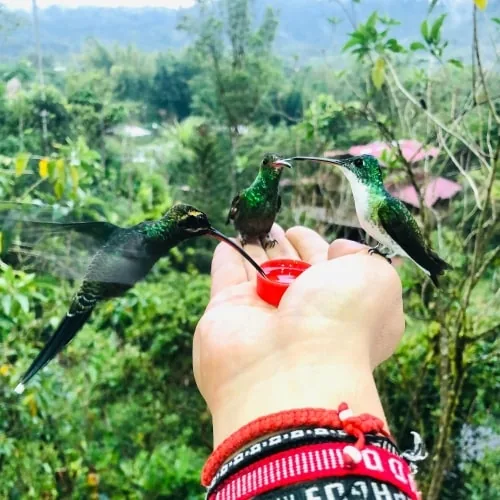
Ecuador is smaller than the US state of Arizona, and it holds more bird species than the United States and Canada combined. That sentence does most of the work of explaining why birders with limited vacation time keep coming back here: the country compresses an absurd range of habitats into short driving distances, and Mindo — two hours from Quito — is the easiest place to step into one of the richest of them.
Why Ecuador is so rich
Three factors stack:
- The Andes. The mountains create altitude bands, and each band has different species. Ecuador also sits at the point where the Andes split into two cordilleras, adding valley habitat between them.
- The equator. No winter, no dormant season — year-round activity and, over evolutionary time, relentless species production.
- Two oceans and the Amazon. Coastal dry forest, cloud forest, páramo, and Amazon rainforest all fit inside one small country, each with its own specialists.
The headline consequence: more than 450 bird species have been recorded in the Mindo area alone — a figure many entire European countries cannot match nationally.
What a "biodiversity hotspot" actually means
The term has a technical definition: a region with exceptional concentrations of endemic species (found nowhere else) that has lost most of its original habitat. Hotspots are therefore both irreplaceable and threatened — the two criteria together. Conservation International recognizes 36 worldwide.
Ecuador sits inside two of them, and Mindo sits in the more relevant one: the Chocó Andino, the cloud forest belt on the western slope of the Ecuadorian Andes. The Chocó's isolation — sandwiched between the Andes and the Pacific, cut off from the Amazon — drove millions of years of independent evolution. The result is a bundle of endemics: plate-billed mountain toucan, violet-tailed sylph, velvet-purple coronet, and dozens more species that exist nowhere else. When habitat here goes, those species go with it.
Mindo's place in the national picture
For a small town — around 1,200 residents — Mindo carries an outsized share of Ecuador's birding reputation:
- The Mindo Christmas Bird Count has repeatedly topped 400 species in a single day, ranking among the best counts in the world — for a single count circle.
- Around 60 certified birding guides work out of town, an infrastructure almost no rural destination of this size has anywhere.
- Reserves in the surrounding Chocó Andino — including Paz de las Aves, with 458 species on its eBird hotspot — protect mid-elevation forest that is exactly the habitat the endemics need.
For a traveler, the practical meaning is this: in a two-hour drive from Quito's airport you go from high Andean city to a valley where a single day can produce 30+ hummingbird species, a cock-of-the-rock lek, and a night walk with glassfrogs. No other hotspot country makes its best cloud forest this accessible.
The other Ecuador, briefly
Fairness matters when you plan a trip: the Chocó is not the only show.
| Region | What it's known for |
|---|---|
| Chocó Andino (Mindo) | hummingbirds, tanagers, endemics, accessibility |
| Amazon lowlands | monkeys, macaws, big rivers; longer travel times |
| Galápagos | unique wildlife, tame animals; expensive, regulated |
| Southern Andes / páramo | condors, high-altitude specialists |
Most serious trips to Ecuador combine two of these. We obviously think the cloud forest belongs in every combination — see Mindo vs the Ecuadorian Amazon if you are choosing between them, and our pages on Galápagos and Mindo combos if you are doing both.
Why the hotspot status should change how you travel here
Hotspot status is a warning label, not a trophy. The Chocó Andino's forests survive around Mindo largely because tourism pays: entry fees, guide wages, lodge stays. Every one of those is a decision landowners watch. The practical takeaways — stay overnight rather than day-trip, hire local guides, respect trail rules — are on responsible tourism in Mindo.
Keep reading
- Cloud forest explained — the habitat that makes the hotspot
- Mindo wildlife guide — the species the hotspot protects
- Responsible tourism in Mindo — traveling like it matters
- Birdwatching in Mindo — the complete guide
Facts checked: September 2026