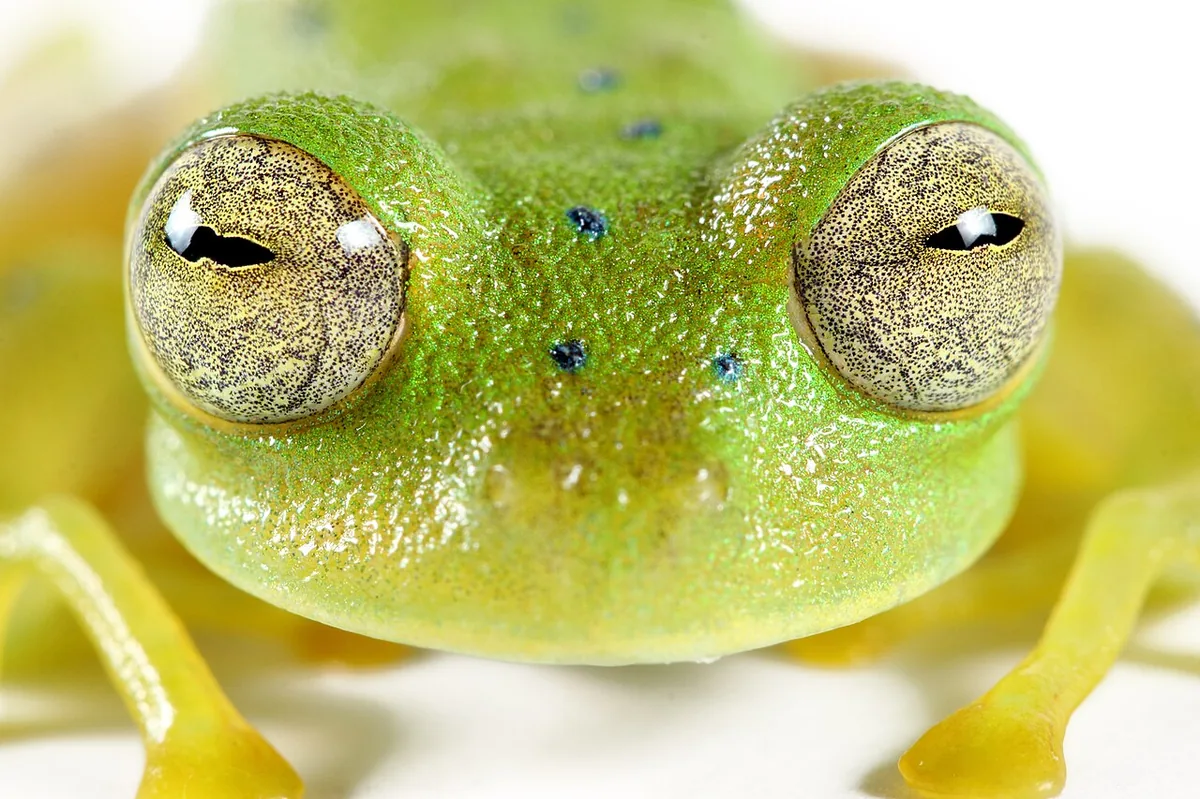
Photo: Santiago Ron from Quito, Ecuador Santiago R. Ron-FaunaWebEcuador (CC BY 2.0) via Wikimedia Commons
A glassfrog sits on a leaf above a stream, and you can count its bones. The skin on its belly is so thin that the heart, the liver, the looping line of the intestine show through. When individuals of some species fold their legs, the green of their backs blends into the leaf and the transparent parts vanish entirely. It is the single most memorable thing most visitors see on a Mindo night walk, and it happens a ten-minute drive from town.
What a glassfrog is
Glassfrogs are a family of small Neotropical frogs, mostly green, a few centimeters long, named for the translucent skin on their undersides — and in some species, over much of the body. Their transparency is real camouflage: against a leaf seen from below, shadows are what give an animal away, and glassfrogs produce fewer of them.
Two habits make them findable. First, they are nocturnal and stream-associated: adults sleep on leaves by day and move to vegetation over running water at night, where males of many species guard clutches of eggs laid on the leaf itself. Second, like many nocturnal animals, their eyes reflect a flashlight beam, so a guide sweeping a light along streamside vegetation picks up pairs of bright points before anything else.
Why Mindo is good glassfrog country
Everything the family needs concentrates here: perennial streams, air that stays humid through the dry months, deep leaf litter, and a forest canopy that keeps the understory from ever drying out. Mindo sits inside the Chocó Andino hotspot, one of the world's most amphibian-rich regions, at mid-elevation in the cloud forest belt where moisture is near-constant — rain showers are frequent especially from late October through April.
We will not print a species count for Mindo's glassfrogs. Amphibian inventories shift with every survey, identification is genuinely hard, and we refuse to invent numbers. What we can say honestly: on a good night walk here, guides regularly find glassfrogs, and finding one is considered a successful night even when the kinkajous stay hidden.
The night walk: how it works
Night walks near Mindo run after dinner, typically starting around 7:00-7:30 PM, and last about two hours at a slow pace. A guide carries the light and does the finding; your job is to walk carefully and point at things you think are leaves.
What usually turns up over an evening, besides glassfrogs:
- Stream and tree frogs of several kinds, calling in layers of sound
- Insects that deserve their own documentary: katydids, lantern flies, glow-in-the-dark fungus gnats
- Snakes occasionally, always admired from a distance
- The frog chorus itself, which peaks after rain
Costs and operators vary; check current prices locally or ask us at the lodge — we book walks with guides we know. Closed shoes with grip, long pants, a rain layer. Leave the white flashlight mode to your guide's setup; some operators use red light to keep the animals calm.
Seeing them without harming them
Amphibians breathe through their skin, which makes them unusually fragile to what humans bring into the forest. The etiquette is short:
- Never touch or handle a frog. Sunscreen, insect repellent and hand oils can poison skin contact for them.
- Do not move leaves, branches or egg clutches for a better photo.
- Keep flashes off frogs and keep your light time short.
- Stay on the trail; stream banks are both habitat and the fragile edge of it.
Chytrid and why guides get serious
Amphibians worldwide are in trouble, and the Chocó is not exempt — the fungal disease chytridiomycosis has hit Andean frog populations hard, which is one reason population numbers for any site are contested and why we do not quote them. Reserves and guides around Mindo treat every frog encounter as something worth protecting rather than a photo prop. When your guide stops you from touching one, that is the whole conservation strategy in one gesture.
When to go
Glassfrogs are active year-round in Mindo — the forest does not have a cold season to sleep through. Wet nights after an afternoon shower produce the best calling and activity, which makes the rainy months (late October through April) reliably good, though any month can deliver. Combine a night walk with a daytime visit to the reserves: see night walks in Mindo for logistics.
Keep reading
- Mindo wildlife guide — the whole animal cast
- Cloud forest explained — why amphibians thrive here
- Night walks in Mindo — booking and practical details
- Best time to visit Mindo
Facts checked: September 2026